- Main Menu
 Focus and Scope
 Section Policies
- Copyright
 Peer-Review Process
 Publication Frequency
 Publication Ethics
- Indexing & Abstraction
 Article Processing Charge
 Contact Us
- Information
 Visitor Statistics
 Copyright & License
 Open Access Policy
 Editorial Board
- Peer Reviewer
 Plagiarism Policy
- Policy on The Use of GenAi
- Statement on the Use of Generative AI
- Long Term Preservation
- Repository Policy
- Template dan Author Guidlines


- Partnership

- Tools


- Citedness in Scopus

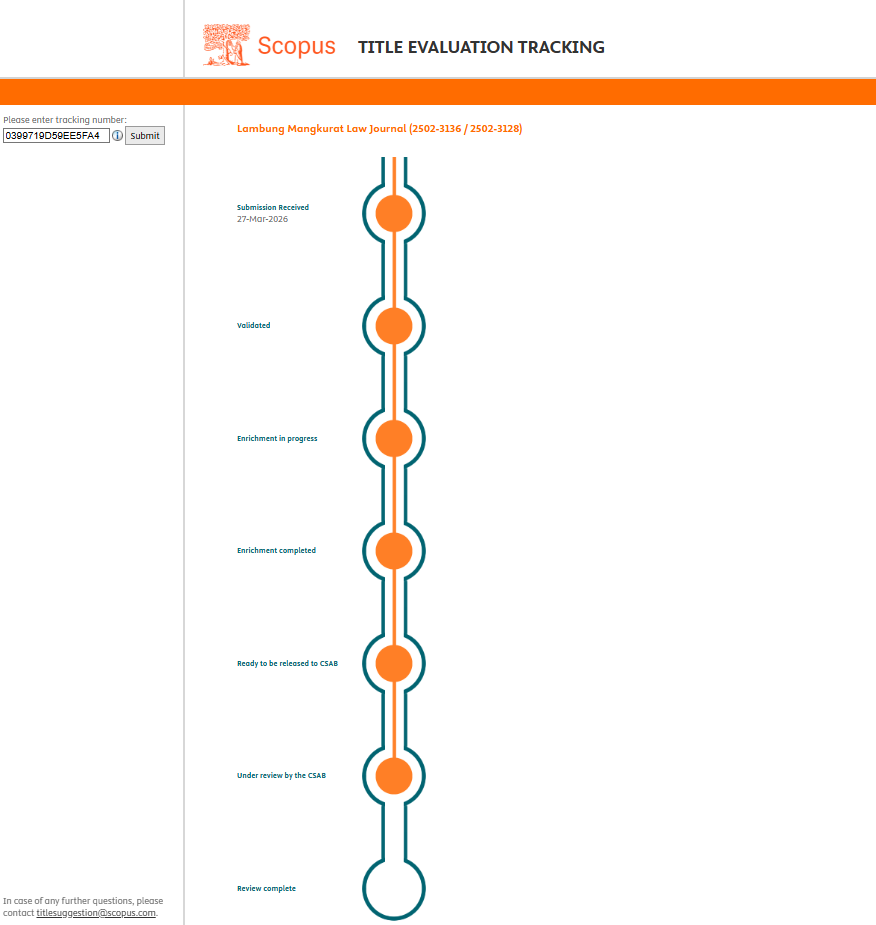
- TITLE EVALUATION TRACKING
- Visitor Count
View My Stats
Peer Review Process
Lambung Mangkurat Law Journal (LamLaJ) will publish the only paper strictly following LamlaJ guidelines and preparation of the manuscript. The paper is read by members of the editor (based on areas of specialization) and will be filtered by the Managing Editor to meet the criteria required for the publication of LamlaJ . Manuscripts will be sent to two peer reviewers based on their historical experience in reviewing manuscripts or their specialization areas. LamLaJ has a review form to keep the same item reviewed by two reviewers. Then the editorial board will make decisions based on comments or suggestions from reviewers. Reviewers will give their assessment on originality, clarity of presentation, and contribution to the field/science, LamlaJ has three kinds of decisions:
- Accepted, as it is. The journal will publish the paper in its original form;
- Accepted by Minor Revisions, the journal will publish the paper and asks the author to make small corrections (let authors revised with stipulated time);
- Accepted by Major Revisions, the journal will publish the paper provided the authors make the changes suggested by the reviewers and/or editors (let authors revised with stipulated time);
- Resubmit (conditional rejection), the journal is willing to reconsider the paper in another round of decision making after the authors make major changes;
- Rejected (outright rejection), the journal will not publish or reconsider the paper even if the authors make major revisions.
To check plagiarism, the LamlaJ Editorial Board will manually filter plagiarism in the title and abstract of the manuscript using the Google engine. If indications of plagiarism are found, the editorial board will immediately reject the manuscript.
Copyright arrangements are set out separately on the Copyright and Licensing page. LamLaJ does not require authors to transfer copyright. Upon acceptance, the corresponding author confirms a non-exclusive licence to publish, and the article is published under a Creative Commons Attribution-ShareAlike 4.0 International License.