- Main Menu
 Focus and Scope
 Section Policies
- Copyright
 Peer-Review Process
 Publication Frequency
 Publication Ethics
- Indexing & Abstraction
 Article Processing Charge
 Contact Us
- Information
 Visitor Statistics
 Copyright & License
 Open Access Policy
 Editorial Board
- Peer Reviewer
 Plagiarism Policy
- Policy on The Use of GenAi
- Statement on the Use of Generative AI
- Long Term Preservation
- Repository Policy
- Template dan Author Guidlines


- Partnership

- Tools


- Citedness in Scopus

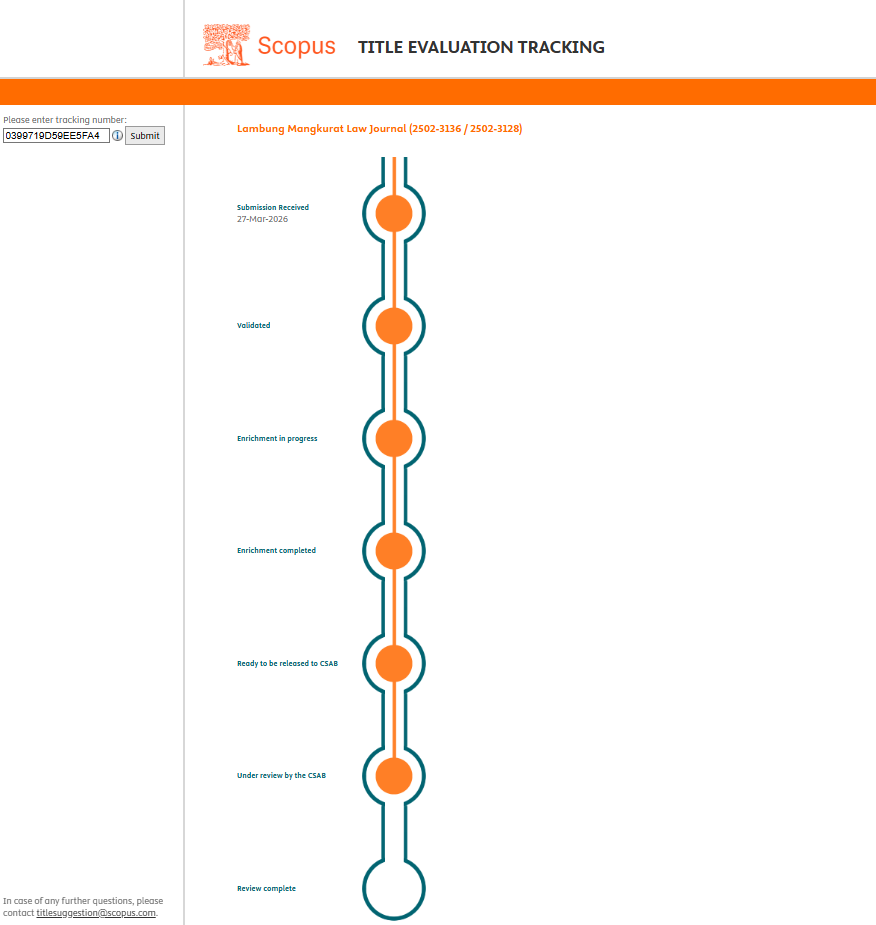
- TITLE EVALUATION TRACKING
- Visitor Count
View My Stats
Author Guidelines
Lambung Mangkurat Law Journal
Please read and understand the author's guidelines for the preparation manuscript. The author who submits a manuscript to the editors should comply with the author's guidelines and template. If the submitted manuscript does not comply with the guidelines or using a different format, it will be rejected by the editorial team before being reviewed. The editorial team will only accept a manuscript that meets the specified formatting requirements (downloadable at: Template and Author Guidelines). This template is designed to assist Author in preparing manuscript; it is an exact representation of the format expected by the editor. To use this template, please just Save As this MS Word file to your document, then copy and paste your document here. All papers submitted to the journal should be written in English language.
- Lambung Mangkurat Law Journal (LamLaJ) contains original research articles or analytical articles that have not been published before;
- The languages used in this journal are Indonesian and English
- Manuscripts are typed usingfont Times New Roman, size font12,with 1.5 spacing on A4 paper. The minimum number of pages is 12 and a maximum of 30 pages (including bibliography/bibliography).Margin :above And base4 cm,Right And skin3 cm.
- The writing system consists of:Title(ideally no more than 14 words;Writer's name(without academic degree);Abstract(maximum 200-300 words made in English, which contains a summary of the research, research methods and results), and keywords);Introduction(contains a description of the background and formulation of the problem); methods(generally consists of types of research, types of research; approach methods, research locations; sources of legal materials; techniques for collecting legal materials/data and analysis of legal materials/data),Analysis and Discussion(description of analysis of research results),Conclusion(contains descriptions of conclusions and suggestions), and reference (Turabian Citation Style Guide 9th Edition.)
- Each text uses citation technique footnotes (times new roman 10 font).
The footnotes are written in the order of: Author, Book Title in italics, City, Year of Publisher, Year . Example
1Erich Kurniawan Widjaja and Willian Tandya Putra, “Karakteristik Hak Kebendaan Pada Objek Jaminan Fidusia Berupa Benda Persediaan,” Jurnal Mercatoria 12, no. 1 (2019): 14–28.
2Fred K Skousen, Akuntansi Keuangan (Jakarta: Salemba Empat, 2015).
- Reference: minimum 25 (twenty five) reference books and journals. Only references used as citations may be listed in the bibliography. The order of writing is; last name is put in front, Year,Italic book title, City: Publisher.
Contoh:
Mispansyah, and Amir Ilyas. Tindak Pidana Korupsi Dalam Doktrin Dan Yurisprudensi. Cetakan I. Depok: PT Rajagrafindo Persada, 2016.
Wulansari, Rizky Juliani, Yulia Qamariyanti, and Erlina Erlina. “Right of Access to Area of Depreciated Land Regulation with the Law Perspective of Land Registry in Indonesia.” Lambung Mangkurat Law Journal 4, no. 2 (2019): 222–233. http://lamlaj.ulm.ac.id/web/index.php/abc/article/view/132.
“Noken Papua Mendapat Pengakuan UNESCO.” British Broadcasting Corporation. Last modified 2012. Accessed January 1, 2018. https://www.bbc.com/indonesia/berita_indonesia/2012/12/121205_noken_unesco.
The Writing should not not use chapter separation with numbers. The division between Titles, Sub-Titles, and Sub-Titles is written in the following order:
CAPITAL BOLD;
Bold;
Bold Italic; and
Italic
- The table (if any) is added to the open model (no vertical lines)
- The author attaches a summaryway of lifeincludingfull name, place and date of birth, educational history, address of the agency/agency where he is assigned(office phone number,facsimileAndcellphone), Andemail address.
- Every manuscript submitted to the NoLaJ editor willreviewedby the Editorial Board and two Peer Reviewer sbased on their area of expertise. Correspondence is carried out via e-mail usingOpen Journal System(OJS).